PROGRAM
Program Framework
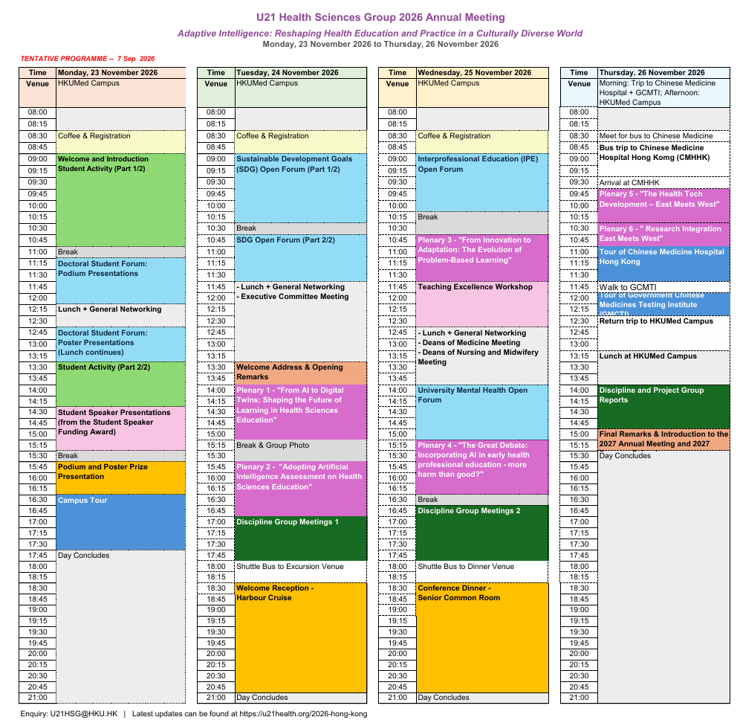
We are pleased to share the programme framework for the U21 HSG 2026 Annual Meeting.
This provides a at‑a‑glance overview of the 2026 Annual Meeting, outlining key components such as plenary sessions, forums, workshops, networking opportunities, and site visits.
Designed to offer both structure and flexibility, the framework gives participants an initial sense of how the meeting will unfold across the different days, with further details on individual sessions to be released in due course.
Program as of 6 Nov 2026

Plenary Topics
We are pleased to share the plenary session topics for the U21 HSG 2026 Annual Meeting.
Aligned with this year’s theme, “Adaptive Intelligence: Reshaping Health Education and Practice in a Culturally Diverse World,” the plenaries will bring together global perspectives on emerging trends in health sciences education, technology, and practice.
These sessions are designed to spark dialogue, foster collaboration, and explore how adaptive approaches can shape the future of healthcare across diverse contexts.
Session Description
Plenary 1
Tuesday 24 November at 1:45pm
From AI to Digital Twins: Shaping the Future of Learning in Health Sciences Education
Plenary 1 explores the organic integration of AI, virtual reality and digital twins in health sciences education. Dragan Gašević, HKU’s Chair Professor of Learning Analytics and Artificial Intelligence, will examine AI’s impact on teaching, learning and assessment, and the capabilities students and faculty need for productive human–AI collaboration. Hyunmi Park, Associate Professor of Medical Education at Korea University, will discuss VR in clinical medicine and chatbots in biomedical sciences for medical students. Will Qiao, Clinical Assistant Professor in Restorative Dental Sciences at HKU, will share VR and AI applications in clinical teaching. The insightful lectures will be followed by a panel discussion to further explore opportunities, challenges and future directions for integrating these technologies into health sciences curricula.
Plenary 2
Tuesday 24 November at 3:45pm
Cultural Dimensions of AI in Health Education: A Chatbot-Guided Self-Reflection Approach
Explore key perspectives on generative AI in health sciences education, including culturally grounded AI literacy and AI-supported reflective learning. Participants will engage in small-group activities to critique and co-develop culturally responsive GenAI literacy competency frameworks, as well as use a reflective learning chatbot to deepen clinical reflection.
Plenary 3
Wednesday 25 November at 10:45am
From Innovation to Adaptation: The Evolution of Problem-Based Learning
In this plenary, our speakers will examine the historical origins and evolution of problem-based learning (PBL) in health sciences education in response to different learner, curriculum and clinical practice needs. The speakers will provide insights from three culturally diverse contexts (Canada, Mexico, and Hong Kong), giving participants practical strategies for adapting problem-based learning to sustain educational relevance and integrity in the era of generative AI. The session will conclude with a panel discussion to further explore the opportunities and challenges for adapting problem-based learning to meet the contemporary needs of health sciences students.
Plenary 4
Wednesday 25 November at 3:30pm
The Great Debate: Incorporating AI in early health professional education - more harm than good?
Artificial intelligence (AI) has revolutionised undergraduate education. This fundamental change in how students learn poses a foundational dilemma for health sciences educators: do generative AI tools help or hurt students? Is AI in early undergraduate education a bicycle or a crutch for the early learner's mind? This interactive debate session pits student-teacher teams to debate this question while also charting out the synergistic role of adaptive intelligence (AI combined with human expertise) in mitigating harms and maximizing benefits of AI in health sciences education.
Plenary 5
Thursday 26 November at 9:30am
The Health Tech Development – East Meets West
Explore the intersection of Eastern and Western health technologies, focusing on international collaborations, emerging trends, and their transformative potential for global healthcare delivery.
IPE Forum: Developing Resilience in Healthcare Teams Through the IPE Lens as Part of Adaptive Intelligence (the synergy of AI with human expertise)
Wednesday 25 November at 9:00am
This 45‑minute workshop equips health professions educators to facilitate discussion on Resilient Adaptive Intelligence (RAI), defined as the integration of Artificial Intelligence (AI) capabilities with human expertise, interprofessional collaboration, and team resilience. Framed within the U21 Health Sciences Group 2026 theme of “Adaptive Intelligence,” the session explores how Interprofessional Education (IPE) can help healthcare teams effectively combine AI-supported insights with human judgment, ethics, empathy, and contextual decision-making. Participants are introduced to key concepts including collaborative intelligence, cognitive flexibility, psychological safety, collective sense-making, and continuous learning, before working through interactive clinical and academic case scenarios where AI recommendations conflict with professional judgment, patient preferences, or contextual realities. The workshop will encourage discussion on balancing AI output with human expertise, managing uncertainty, promoting patient-centred care, and strengthening teamwork across disciplines.
By the end of the workshop, participants will be able to:
Explain resilient adaptive intelligence as a systems-based capability involving patients, interprofessional teams, AI technologies and organisational conditions.
Apply a structured process to critically evaluate an AI-supported recommendation in a culturally and clinically complex scenario.
Identify one feasible change that could strengthen AI-informed IPE in their educational setting.